Seasons & celebrations
Diwali sweets: what to give, what to check on the box, and the 2026 dates
A plain guide for anyone giving sweets to a Hindu, Sikh or Jain neighbour or colleague: what the sweets are, what to check on the box, and the London dates for 2026.
Diwali sweets are mithai: small, rich sweets made mostly from milk, sugar, ghee, gram flour and nuts, such as ladoo, barfi, kaju katli, peda, jalebi and gulab jamun. Boxes of them are the usual gift at Diwali, and giving one to a Hindu, Sikh or Jain neighbour or colleague is a normal, welcome thing to do. In 2026 the main day of Diwali falls on Sunday 8 November in London, so the week before is the time to hand a box over. Traditional mithai contain no meat, but "vegetarian" on a box does not always mean egg-free, so read the label for egg, gelatine and silver leaf if the person keeps a strict diet.
Diwali 2026: the dates, and when to give sweets
Diwali usually lasts five days around a new moon between mid-October and mid-November, so the date moves every year. Imperial College London's staff guide describes a festival of lights celebrated by Hindus, Jains and some Sikhs and Buddhists, with homes lit by diyas (oil lamps), worship of Lakshmi, and families sharing mithai and exchanging gifts. Sikhs mark Bandi Chhor Divas at the same time of year. "Happy Diwali" or "Happy Bandi Chhor Divas" both work as greetings; if you are not sure which a friend celebrates, ask.
The Drik Panchang almanac's London calendar puts Diwali and Lakshmi Puja on Sunday 8 November 2026, within five days from Friday 6 to Tuesday 10 November (set out day by day by HinduTone). Drik Panchang works each day out from local sunrise, so in 2026 Naraka Chaturdashi, Govardhan Puja and Bhai Dooj fall a day earlier in the UK than in India, and some families follow their own temple's dates instead.
Because 8 November is a Sunday, an office box on Thursday 5 or Friday 6 November reaches people before the family weekend. For neighbours, any day in the run-up works. For an evening out that weekend, see our Harrow fireworks guide.
Milk-based sweets generally keep less long than dry ones, so check the date and storage instructions when you buy and leave enough life on the box for the person receiving it. The government's guidance on date labels explains that a use-by date is about safety and a best before date is about quality.
The common Diwali sweets, by name
The first seven usually come in a shop mithai box; the last three are served in a bowl, at home more than in gift boxes. Recipes vary by region and family.
| Sweet | What it is | Usually contains |
|---|---|---|
| Ladoo | Balls of gram flour, boondi or coconut, with ghee | Milk (ghee), nuts; wheat in some |
| Barfi | Fudge-like squares of thickened milk | Milk, nuts, silver leaf |
| Kaju katli | Thin diamonds of cashew and sugar | Cashew, silver leaf; often ghee or milk |
| Peda | Small discs of thickened milk | Milk |
| Gulab jamun | Fried milk-dough balls in syrup | Milk, wheat |
| Jalebi | Fried batter spirals in syrup | Wheat, milk (ghee or yoghurt), colour |
| Soan papdi | Flaky cubes of gram flour, sugar and ghee | Milk, nuts, wheat |
| Rasgulla, rasmalai | Curd-cheese balls in syrup or sweet milk | Milk |
| Halwa | Pudding of semolina or carrot (gajar) | Milk; wheat (semolina) or carrot |
| Kheer | Rice slowly cooked in milk | Milk, nuts |
This is a typical guide, not an allergen list, and there is no reliable UK ranking of the most popular sweet. Almost every sweet here is built on milk or ghee, so a standard box will not suit a vegan, and anyone with a milk or nut allergy needs to read the label. Traditional versions are normally made without egg or gelatine; the risk comes from cake slices, mousse, jelly sweets, marshmallow and silver leaf.
Is it OK to give Diwali sweets to a Hindu colleague?
Yes. Sharing sweets is the custom, and Imperial's guide suggests teams can mark the festival together, for example with a pot-luck lunch. A small box and a "Happy Diwali" card is plenty. As a rough rule of thumb, allow one or two pieces per person plus a few spare.
What matters is the person's diet. Yale's chaplaincy summary of faith diets says Hindu practice varies: many avoid beef, vegetarianism is common but not universal, and some eat eggs while others do not. Jains do not eat meat, eggs or honey, and many avoid root vegetables such as onion, garlic, potatoes and carrots. Many Sikhs are vegetarian and do not eat eggs.
- Choose a box of traditional milk, nut and gram-flour sweets.
- Leave out anything with alcohol, such as liqueur chocolates, and anything containing meat products, including gelatine.
- For a Jain friend, skip carrot halwa and anything with honey. Yale notes that many Jains are entirely vegan, so look for sweets labelled vegan or dairy-free.
- For someone who avoids eggs, do not rely on the word "vegetarian" alone. Read the ingredients.
- For someone diabetic or cutting down on sugar, ask the shop about sugar-free or reduced-sugar sweets.
- If food is too hard to get right, small clay diyas or tea lights fit the festival.
- If you know the person well, the simplest thing is to ask what their family eats.
What to check on the box: egg, gelatine and silver leaf
Under the Food Standards Agency's allergen rules for England, Wales and Northern Ireland, what a box must tell you depends on how it was packed. Eggs and milk are both among the 14 major allergens.
- A sealed, prepacked box must list its ingredients, with the 14 allergens emphasised (for example in bold) every time they appear.
- A box the shop filled in advance and sells from its own counter also needs a full ingredients list.
- Sweets picked loose into a box in front of you carry no label, but the shop must still tell you about allergens. It can do that by word of mouth, as long as a notice tells you to ask.
- Egg. It will be emphasised in the ingredients list.
- Gelatine. It comes from animals, usually pork or beef, so it rules a sweet out for vegetarians, and beef gelatine is a problem for the many Hindus who avoid beef. Pork gelatine is forbidden in Islam, per Yale's summary, and many Muslims avoid any gelatine not labelled halal. Plant-based setting agents such as agar avoid the question.
- Silver leaf. The shiny foil on barfi and kaju katli is edible silver, which appears on UK labels as "silver" or E174, one of the approved colours on the FSA list. It was traditionally made by beating silver between layers of cow or buffalo intestine. India's food regulator, FSSAI, banned animal material at any stage of making silver leaf in regulations dated 15 July 2016, in force from August 2017. A UK label will not say how the leaf was made, so if that matters, ask the shop or choose sweets without it.
- Red and pink colours. Cochineal, listed as E120 or carmine, is an approved colour made from crushed insects. The Vegetarian Society's criteria exclude insects, so check for it if the person avoids animal products.
- Nuts. Cashew, pistachio and almond are everywhere in mithai. If you do not know the household's allergies, a nut-free option is the cautious choice.
Halal and vegetarian: where the two overlap
If you keep halal and are buying for a vegetarian friend, or the other way round, the labels check different things.
| Label | What it means | Can still contain |
|---|---|---|
| Halal | No pork or alcohol; any meat or gelatine must be halal | Egg; halal gelatine, which can be beef |
| Vegetarian (Vegetarian Society mark) | No meat, fish, gelatine or slaughter by-products | Egg |
| Vegan | No animal products, including milk, ghee and egg | Nuts, wheat and other allergens |
| Egg-free | No egg in the recipe | Gelatine; meat |
Vegetarian and vegan labels are about animal products, not alcohol, so neither rules alcohol out. A halal sweet can still contain egg or beef gelatine, which a strict Hindu vegetarian would avoid. For traditional mithai the overlap is wide: milk, sugar, ghee, flour and nuts raise no question under either label, and egg, gelatine and silver leaf are where they diverge.
Can Muslims accept Diwali sweets?
Scholars differ on receiving the sweets and on greeting.
- The fatwa department at Darul Uloom Deoband, in a short ruling, says Diwali sweets may be eaten if they have not been offered in the name of a god or goddess. SeekersGuidance says food that is simply a seasonal custom may be accepted, but food that was part of a ritual or offered to deities may not.
- The Permanent Committee fatwa published by IslamQA.info is stricter: it says it is not permissible to eat or accept food made for non-Muslim festivals.
- On greeting, Egypt's Dar al-Ifta sees no objection to congratulating peaceful non-Muslims on their religious occasions, while IslamQA.info's answer 947 says congratulating them, or exchanging gifts for their festivals, is not allowed.
- Where food has been offered in worship, such as temple prasad, SeekersGuidance notes that you can decline politely without causing offence.
Which view to follow is a question for your own scholar or imam. Cha Cha Chai does not give rulings.
Diwali-style desserts at Cha Cha Chai
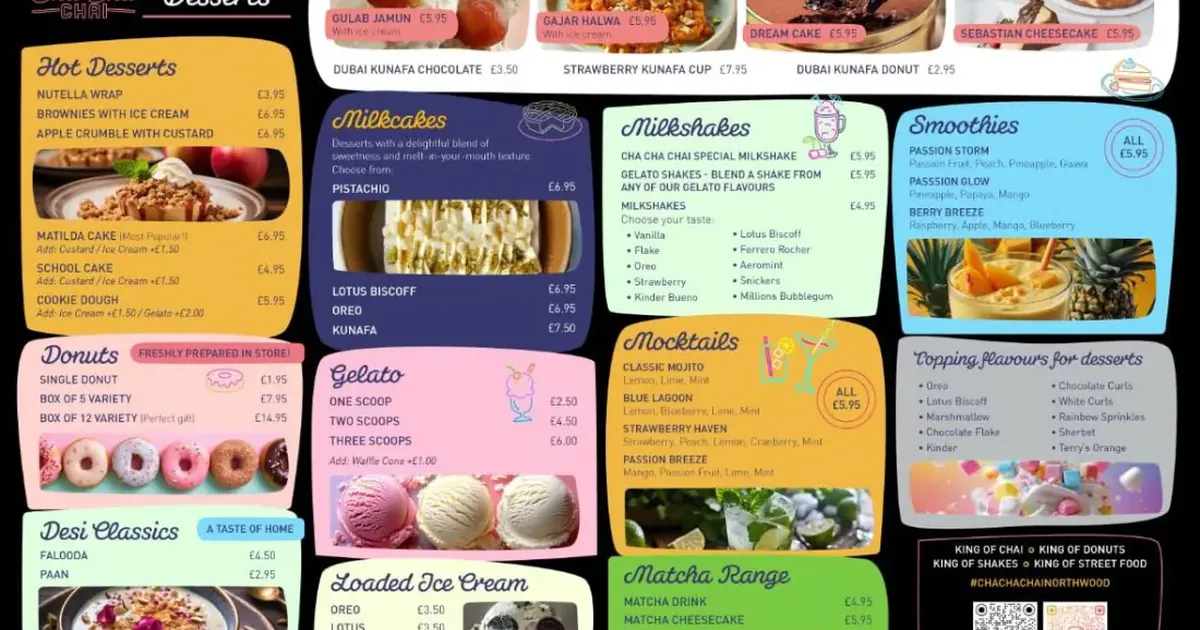
There is no Diwali range or boxed mithai on our menu, so for a traditional box to give away, a mithai shop is the right place. To ask whether the kitchen is doing anything for Diwali this year, call 01923 940269. If you would rather eat gulab jamun or gajar halwa than give them, they are on the dessert menu. From the full menu:
- Gulab Jamun with ice cream, £5.95, one of the starred customer favourites
- Gajar Halwa, £4.95, or with ice cream at £5.95
- Kheer, £4.95
- Falooda, £4.50
The dessert menu does not mark items as vegetarian or egg-free. If a friend avoids egg or gelatine, ask the team about each one, including the ice cream and any jelly in the falooda. The halal page explains what our halal menu covers.
Questions people ask
What sweets are given at Diwali?
The usual gift is a box of mithai: ladoo, barfi, kaju katli, peda, soan papdi, jalebi and gulab jamun are all common. Most are made from milk, sugar, ghee, gram flour and nuts.
Is it OK to give Diwali sweets to Hindu colleagues?
Yes. Sharing sweets is the Diwali custom, and a small box for the team with a Happy Diwali card is welcome. Choose traditional milk and nut sweets, avoid alcohol and gelatine, and check for egg. In 2026 the main day is Sunday 8 November, so bring the box in by Friday 6 November.
What is the most popular Diwali sweet?
There is no reliable UK ranking, and favourites depend on region and family. Ladoo, barfi, kaju katli and soan papdi are all common in shop-bought boxes.
Are Diwali sweets vegetarian and egg-free?
Traditional mithai contain no meat and are normally made without egg, but almost all contain milk or ghee, so they are not vegan. Boxes that add cake, mousse, jelly or marshmallow can contain egg or gelatine, so read the ingredients.
Can Muslims eat Diwali sweets?
Scholars differ. Darul Uloom Deoband and SeekersGuidance say such sweets may be eaten if they have not been offered to a deity or used in a ritual, while the Permanent Committee fatwa published by IslamQA.info says not to eat or accept them. Views on greeting differ too, and the stricter view also rules out exchanging festival gifts. That is a question for your own scholar or imam.
Sources and how we checked
Menu prices and shop details come from our own menu as it stands on the date below. Facts about anything else were checked against the sources listed here. Prices and dates change, so check before you travel for something time-sensitive. If you spot something wrong, call us on 01923 940269 and we will correct it and note the date.
- Diwali 2026 in the UK: Lakshmi Puja Muhurat City by City, Dhanteras Timings and the 5-Day Calendar, HinduTone. Checked 16 October 2026. Sets out the five UK days from the Drik Panchang almanac's London calendar, which we also read directly on 16 October 2026 (same dates). Some families follow their own temple's dates.
- Diwali and Bandi Chhor Divas, Imperial College London. Checked 16 October 2026. Who celebrates, diyas, Lakshmi (goddess of prosperity and wealth), mithai and gifts, workplace notes.
- Dietary cheat sheet, Yale University Chaplain's Office. Checked 16 October 2026. General summary of Hindu, Jain, Sikh and Muslim dietary practice (Islam: pork including gelatin forbidden; meat must be halal; many Jains entirely vegan); individuals vary.
- Trademark Criteria, Vegetarian Society. Checked 16 October 2026. Approved vegetarian mark excludes meat, fish, insects, gelatine and other slaughter by-products but allows free-range eggs. These are the Society's criteria for its own mark.
- Allergen guidance for food businesses, Food Standards Agency. Checked 16 October 2026. Ingredient and allergen labelling for prepacked, PPDS and loose food.
- Approved additives and E numbers, Food Standards Agency. Checked 16 October 2026. E174 silver and E120 cochineal are approved colours.
- Silver leaf (VRG blog, 15 August 2016), The Vegetarian Resource Group. Checked 16 October 2026. Describes the traditional method of beating silver leaf between cow and buffalo intestines.
- Is it permissible to consume sweets during the Islamic holiday of Diwali? (Fatwa 129/129/M=1433), Darul Ifta, Darul Uloom Deoband (via IslamQA). Checked 16 October 2026. One scholarly view: allowable if not offered in the name of a god or goddess.
- Can I Consume Food Gifted by Non-Muslims On Their Festivals, SeekersGuidance (Shaykh Abdullah Anik Misra, 8 January 2022). Checked 16 October 2026. Customary festive food may be accepted; food with ritual or religious significance may not.
- Can You Eat Food Made by Non-Muslims for Their Festivals?, IslamQA.info (citing the Permanent Committee, 22/398). Checked 16 October 2026. Stricter view: not permissible to eat or accept food made for non-Muslim festivals.
- Can Mistakenly Received Prasad Be Given to a Poor Non-Muslim or Must It Be Discarded?, SeekersGuidance (Mawlana Ilyas Patel, 22 December 2024). Checked 16 October 2026. On temple prasad: one can decline politely without causing offence.
- Understanding food labelling: Best before and use-by dates, GOV.UK. Checked 16 October 2026. Use-by is about safety, best before about quality; both depend on following storage instructions.
- Silver leaf (Chandi-ka-warq) food grade regulations from 01.08.2017, TaxHeal (republishing FSSAI's Fifth Amendment Regulations, 2016). Checked 16 October 2026. Regulation text dated 15 July 2016: silver leaf must not be manufactured using any material of animal origin at any stage; in force from 1 August 2017. FSSAI's own site could not be reached.
- Permissibility of congratulating non-Muslims on their religious festivals, Dar al-Ifta al-Misriyyah (Egypt), 18 November 2013. Checked 16 October 2026. One view: no objection to congratulating peaceful non-Muslims on their religious occasions. Does not address gifts.
- Greeting Non-Muslims on Their Festivals (Question 947), IslamQA.info (citing Shaykh Ibn 'Uthaymin). Checked 16 October 2026. Stricter view: congratulating non-Muslims on their religious festivals, and exchanging gifts for them, is not allowed.
Written and checked by the team at Cha Cha Chai Northwood Hills, a halal cafe and dessert bar at 56 Joel Street. We are a business and this guide mentions our own menu. Nobody paid to be included.